10 Platforms Where You Can Make Money Online
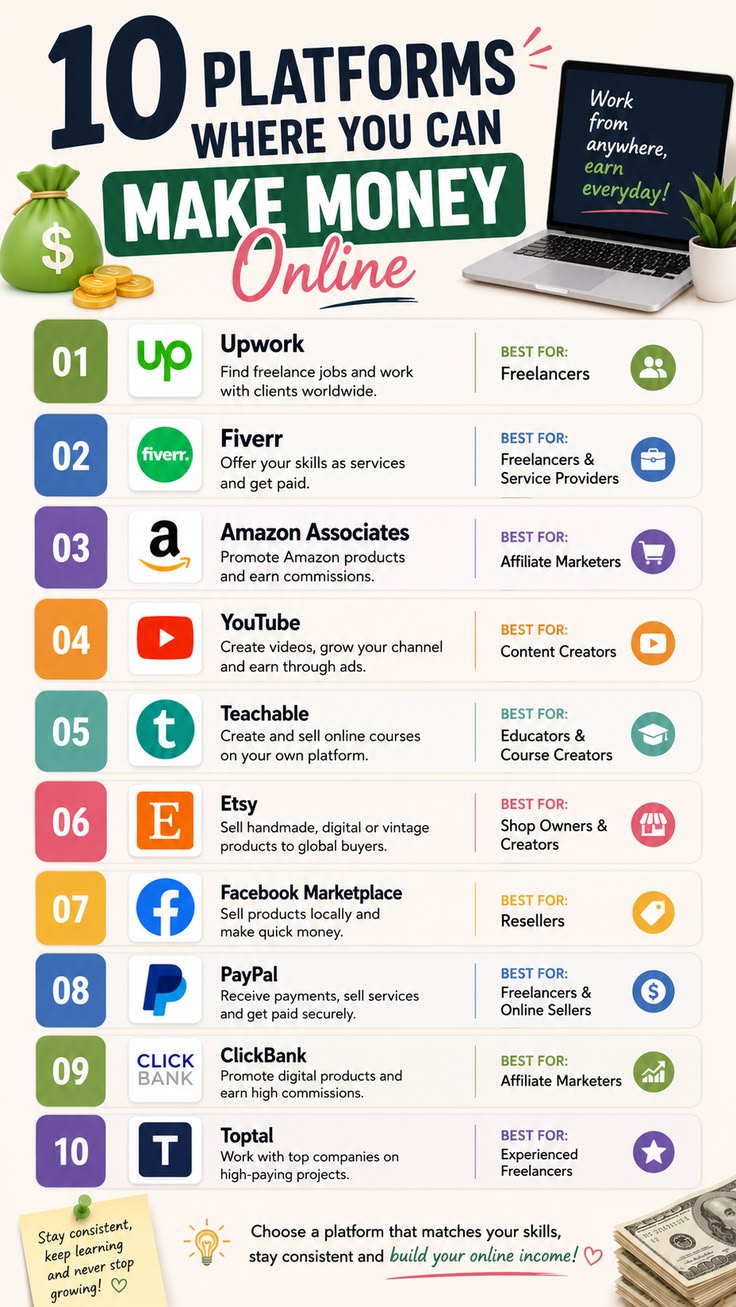
Table of Contents
The Hook: Why Most People Still Aren't Making Money
Everyone's heard of these platforms. Upwork, Fiverr, YouTube, Amazon Associates — they're mainstream knowledge at this point.
Here's the problem: awareness doesn't equal income. The vast majority of people who sign up for these platforms never make meaningful money. Not because the platforms don't work — they do. But because they hit the same wall: traffic.
You need eyes on your offer before any platform can convert them into dollars. And that's exactly where 95% of people get stuck.
This guide covers 10 real platforms where you can make money online — honestly, with the actual pros and cons — so you know what you're walking into. Then we'll talk about the missing piece that makes everything else actually work.
1. Upwork
FreelancingUpwork is the largest freelance marketplace in the world. Businesses post projects; freelancers bid on them. It covers everything from copy writing and graphic design to software development and virtual assistance.
Pros
- ✓ Massive client pool — millions of posted jobs
- ✓ Payment protection ( escrow system)
- ✓ Covers virtually every freelance skill
- ✓ Connects you with global clients
- ✓ Connects you with global clients
Cons
- ✗ Extremely competitive — race to the bottom on price
- ✗ Upwork takes 10-20% in fees
- ✗ Getting first clients is brutal without reviews
- ✗ Clients lowballing has become the norm
Best for: Writers, designers, developers, VAs, and marketers with a proven skill who can differentiate themselves from the crowd.
Realistic earning potential: $500–$5,000+/month depending on skill and experience. Top freelancers charge $100+/hour. Most newbies plateau around $500-$1,000/mo and stall.
Honest take: Upwork works, but the market is saturated. You need either a standout portfolio, a niche specialty, or patience while you build reviews. The first $1,000 is the hardest.
2. Fiverr
FreelancingFiverr is a service marketplace where you list specific "gigs" at set prices. Clients browse and order directly. It's simpler than Upwork in some ways — you don't bid, you just get found.
Pros
- ✓ Easy to get started — no proposal process
- ✓ Clients come to you through search
- ✓ Good for digital products and micro-tasks
- ✓ Upselling add-ons increases average order value
- ✓ Global reach — easy to sell internationally
Cons
- ✗ Platform fees up to 20%
- ✗ Race to the bottom on price (>$5 gigs)
- ✗ Many clients looking for rock-bottom pricing
- ✗ Hard to break out of the $5-$50 range without reputation
Best for: Creative professionals — video editors, designers, voice-over artists, writers — who can package their skills into clear, compelling gigs.
Realistic earning potential: $200–$3,000+/month. Top gig sellers on Fiverr make $5,000-$10,000/mo. The median is much lower. Your first few months will likely be slow.
Honest take: Fiverr rewards those who optimize their gig titles, tags, descriptions, and images. It's a volume game early on. Once you accumulate reviews, things get easier — but it takes months of consistent delivery.
3. Amazon Associates
Affiliate MarketingAmazon Associates is Amazon's affiliate program. You recommend products, share affiliate links, and earn a commission when someone buys through your link. It's one of the most accessible affiliate programs because almost everyone knows and trusts Amazon.
Pros
- ✓ Amazon's trust factor converts well
- ✓ Access to millions of products to promote
- ✓ Easy signup — approved within days
- ✓ Works for any niche with products
- ✓ Cookies last 24 hours (for any product they click)
Cons
- ✗ Commission rates are low — 1-10% depending on category
- ✗ Most niches are heavily saturated
- ✗ Requires significant traffic to earn real money
- ✗ Strict compliance rules — easy to get banned
Best for: Bloggers, content creators, and reviewers who already have traffic or are building a site around a specific niche with product recommendations.
Realistic earning potential: $0-$500/month as a beginner (with small traffic). $500-$5,000+/month once you have a established site with strong rankings. Reaching $10k/month requires serious SEO authority.
Honest take: Amazon Associates is a long game. You need content that ranks, or a following that trusts your recommendations. Starting from zero with no traffic is a rough path — most people give up before month three.
4. YouTube
Content CreationYouTube is the world's second-largest search engine. You create videos, build an audience, and monetize through ads, sponsorships, affiliate links in descriptions, and channel memberships.
Pros
- ✓ Massive reach — 2+ billion users
- ✓ Multiple monetization paths (ads, sponsors, affiliates)
- ✓ Content is evergreen — videos keep generating views
- ✓ Builds audience ownership over time
- ✓ Ad revenue can be very lucrative at scale
Cons
- ✗ Requires video production skills and equipment
- ✗ Algorithm favors established channels
- ✗ Monetization requires 1,000 subscribers + 4,000 watch hours
- ✗ Takes 6-18 months to reach meaningful ad revenue
- ✗ Editing and production is a significant time investment
Best for: People comfortable on camera who can commit to consistent uploading. Best results come from niche expertise — not general vlogs.
Realistic earning potential: Most creators earn $0-$100/month until they hit monetization. At 100k+ subscribers, $1,000-$10,000+/month in ad revenue is realistic. Sponsorships add significant additional income at scale.
Honest take: YouTube is powerful but the upfront investment is real. Equipment, editing, thumbnails, titles, SEO — it's a whole skill set. The creators who win treat it like a business, not a hobby. Consistency matters more than perfection.
5. Teachable
Course PublishingTeachable lets you create and sell online courses. You set up your school, build your curriculum, set your price, and Teachable handles the payment processing and student experience.
Pros
- ✓ All-in-one platform — courses, payments, students
- ✓ You own your audience (email list built through Teachable)
- ✓ Multiple pricing models (one-time, subscription, payment plan)
- ✓ Good for established audiences
- ✓ No ceiling on earnings — you keep most of the revenue
Cons
- ✗ You need an audience BEFORE you create the course
- ✗ Course creation is a significant time investment
- ✗ Competition in popular niches is intense
- ✗ Requires marketing know-how to fill the course
Best for: Experts with an existing audience — coaches, consultants, industry specialists who already have credibility and a list to sell to.
Realistic earning potential: Most new course creators earn $0-$500/month. Those with an established audience and decent conversion can hit $1,000-$10,000/month. The top 1% of Teachable creators earn $100k+/year.
Honest take: Teachable is a great platform, but it's not a traffic source. You bring your own audience. The course is the product; the audience is the prerequisite. Without an existing following, you'll spend months building an audience before making a single sale.
6. Etsy
MarketplaceEtsy is a marketplace for handmade, vintage, and craft items. It expanded to include digital downloads, print-on-demand, and creative services. It's one of the few marketplaces where small sellers can actually compete.
Pros
- ✓ Built-in audience of buyers looking for unique items
- ✓ Low barrier to entry for creative products
- ✓ Digital products have zero production cost
- ✓ Print-on-demand removes inventory risk
- ✓ repeat customers are common for good shops
Cons
- ✗ Etsy fees add up (listings + transaction + payment processing)
- ✗ Saturation in popular niches (printables, svg, etc.)
- ✗ Search algorithm is opaque and changes often
- ✗ You're competing against sellers in low-cost-of-living countries
Best for: Crafters, designers, artists, and creative entrepreneurs with products that have a clear niche. Digital product creators with templates, printables, or design assets do well.
Realistic earning potential: Most Etsy sellers earn under $100/month. Serious sellers with optimized shops and good products earn $500-$5,000/month. Top sellers in the right niches clear $10k+/month.
Honest take: Etsy rewards those who understand SEO for products and have a differentiated offering. Generic listings in saturated categories get buried. The sellers who do well often spend as much time on marketing as they do creating.
7. Facebook Marketplace
MarketplaceFacebook Marketplace is Facebook's local buying and selling platform. Unlike eBay or Amazon, it's designed for local, person-to-person transactions — though you can also run Facebook Shops for broader reach.
Pros
- ✓ Free to list — no fees on most categories
- ✓ Access to your local area — easy local meetups
- ✓ Massive user base — 1 billion+ monthly active users
- ✓ Facebook Shops integration for product selling
- ✓ You can list on Marketplace + in Groups simultaneously
Cons
- ✗ Largely local — geographic limits your buyer pool
- ✗ Not ideal for digital products or services
- ✗ Scam risk — need to be careful with buyers
- ✗ No built-in payment protection for most categories
Best for: Local resellers, thrift flippers, and people selling physical goods in person. Some entrepreneurs use it to test products before building a full e-commerce operation.
Realistic earning potential: $0-$2,000+/month for serious resellers. Most people flip items casually for a few hundred dollars. It's not a scalable business model — it's a good way to make extra cash on the side.
Honest take: Facebook Marketplace is solid for casual selling but limited as a primary income source. The people making real money are usually running an organized reselling operation (buying clearance items, flipping in volume) — not casual sellers.
8. PayPal
PaymentsPayPal isn't a "make money platform" in the traditional sense — but it's the payment backbone for almost every online income stream. Understanding how to use PayPal for invoicing, accepting payments, and running a business is a foundational skill.
Pros
- ✓ Universal payment method — clients expect it
- ✓ Invoice clients directly with PayPal.Me links
- ✓ "PayPal Business" account provides seller protection
- ✓ Integrates with most freelance platforms
- ✓ No monthly fee for basic accounts
Cons
- ✗ Fees of 2.99% + $0.30 per transaction (domestic)
- ✗ Account suspensions can freeze your funds
- ✗ Not a standalone income platform — it's a payment tool
- ✗ Chargeback risk for digital goods
Best for: Freelancers and service providers who need a simple way to invoice clients and accept payments online. Used alongside Upwork, Fiverr, or direct client work.
Realistic earning potential: PayPal itself doesn't generate income — it's a pass-through. Every dollar you earn passes through PayPal, so the fees add up at scale. At $10,000/month in volume, you're paying ~$300 in PayPal fees.
Honest take: PayPal is essential infrastructure, not a strategy. If you're doing any online business, you need a PayPal Business account. But don't mistake having a PayPal account for having a business.
9. ClickBank
Affiliate MarketingClickBank is an affiliate marketplace specializing in digital products — mostly in the make money online, health, and personal development niches. It has some of the highest affiliate commissions available (up to 75% of sale price).
Pros
- ✓ Very high commission rates (up to 75%)
- ✓ Thousands of products across many niches
- ✓ Recurring products = recurring affiliate commissions
- ✓ Each product has real stats (avg earnings per click)
- ✓ Affiliate resources and training available
Cons
- ✗ Many products are low-quality or hype-driven
- ✗ High refund rates in some niches hurt commissions
- ✗ Compliance violations can get you banned
- ✗ Best-performing niches are crowded
Best for: Affiliate marketers who already have traffic channels (email list, blog, social following) and know how to select quality products. Newbies often struggle because the products require audiences to sell.
Realistic earning potential: $0-$500/month as a beginner. With a targeted audience and good traffic, $1,000-$10,000+/month is achievable. Top ClickBank affiliates make $50k+/month — but these are usually people with large email lists and established funnels.
Honest take: ClickBank has a reputation issue — some products are garbage, and the market attracts spammy affiliates. But there are legitimate products with solid conversions. The key is vetting products yourself rather than promoting anything just because the commission is high.
10. Toptal
High-End FreelancingToptal is an exclusive freelance network that matches top-tier professionals (developers, designers, finance experts) with enterprise clients. It's selective — you have to pass a rigorous screening process — but the pay and clients are top-notch.
Pros
- ✓ Premium clients — no lowballing or scope creep
- ✓ Rates significantly above market average
- ✓ Full-time salaried roles available (with benefits)
- ✓ Toptal handles client matching and negotiations
- ✓ No bidding — clients come to you pre-matched
Cons
- ✗ Acceptance rate is ~3% — very hard to get in
- ✗ Screening process takes 2-4 weeks
- ✗ Limited to specific skill categories (dev, design, finance)
- ✗ Time tracking and hourly requirements on some projects
Best for: Experienced developers, designers, and finance professionals who want premium clients without the sales hustle. You need a strong portfolio and several years of experience to pass screening.
Realistic earning potential: $60-$150+/hour depending on role and experience. Most Toptal freelancers work full-time and earn $80k-$200k+/year. Senior developers and finance experts can earn significantly more.
Honest take: Toptal is worth it if you can get in — but that's a big if. The screening process is no joke. If you have the skills and experience to pass, it's one of the best freelance platforms available. If you're junior or mid-level, focus on Upwork or Fiverr first to build your portfolio.
The Missing Piece
Here's what we've observed across all 10 platforms: the people who actually make real money aren't necessarily the most talented or the hardest workers. They're the ones who figured out the traffic question first.
Every platform above requires one thing to work: people seeing your offer. Whether it's your Fiverr gig, your YouTube video, your Teachable course, or your Amazon Associates link — without traffic, nothing converts.
The #1 reason people fail on these platforms is that they treat them as the strategy instead of as the delivery mechanism. They set up a profile and wait. They create a gig and hope. They make a course and assume students will find it.
The shortcut is traffic generation — and the most efficient way we know of for affiliate marketers and online entrepreneurs to generate targeted traffic is OLSP (Online Service Partner Program). OLSP gives you pre-built funnels, done-for-you traffic, and a community that knows how to convert visitors into buyers. No guessing what works. No building from scratch.
The OLSP system has helped thousands of affiliates stop relying on organic luck and start driving consistent, convertable traffic to their offers. If you've tried the platforms above and hit the traffic wall — or if you want to skip that frustration entirely — OLSP is worth a serious look.
It's not a magic button. But it is a proven system for people who are ready to stop hoping for traffic and start generating it.
All 10 platforms in this guide are real. People are making real money on every one of them. But in every case, the limiting factor isn't the platform — it's traffic. Solve that problem first, and any of these platforms can become a significant income stream.